Robot cleaners are becoming small household systems
The robot vacuum has changed from a novelty that wandered around a room into a much more sophisticated home appliance. Current 2026 models combine mapping, obstacle detection, automated docking, vacuuming and increasingly capable mopping systems. Recent products illustrate the direction. Dyson announced the R1 Nurovi and R2 Nurovi in September, while other premium models have pushed suction, edge cleaning and self-maintenance further. WIRED's September 2026 guide also notes a wave of new robot vacuums announced around IFA. The headline numbers can be impressive, but buyers should look past suction claims. A robot that understands the layout of a home and can maintain its brushes and mop system may outperform a machine with a larger specification number but poor navigation.
Navigation is the feature you notice every day
Good navigation changes the experience because the robot spends less time behaving unpredictably. Modern systems can map rooms, recognise obstacles and plan routes rather than simply bouncing between furniture. LiDAR, cameras, structured-light systems and other sensors can be combined in different ways. Each approach has strengths and weaknesses. A camera-based system may identify objects visually, while another sensor can measure distance more consistently in low light. For buyers, the practical question is simple: can the robot move around your home without constant rescue? Check how the machine handles cables, chair legs, rugs, thresholds and narrow spaces. If your home contains lots of clutter, obstacle recognition may matter more than maximum suction.
Mopping is no longer an afterthought
Hybrid vacuum-and-mop machines have become more sophisticated. Some premium models now use rotating rollers or extendable cleaning systems, while docks can wash and dry components automatically. That can reduce maintenance, but it also introduces more parts that require attention. Water tanks, mop rollers, detergent systems and drying mechanisms all need cleaning and occasional replacement. The best choice depends on the floor types in your home. A house with mostly hard floors may benefit significantly from automated mopping. A carpet-heavy home may place more value on strong vacuuming, brush design and reliable carpet detection.
Edge and corner cleaning matters more than laboratory numbers
A robot can perform well in the middle of a room and still leave dust around skirting boards and furniture. Manufacturers are therefore experimenting with extendable brushes, side sweepers and moving mop components. These features are particularly useful in homes with pets, children or hard floors where crumbs accumulate along edges. But mechanical reach represents just one part of the equation. The robot also needs to understand where an edge begins and move close enough to use the mechanism effectively. Look at independent reviews that test corners, furniture clearance and mixed floor surfaces. Real-world performance often reveals differences that a specification sheet cannot.
The dock is part of the appliance
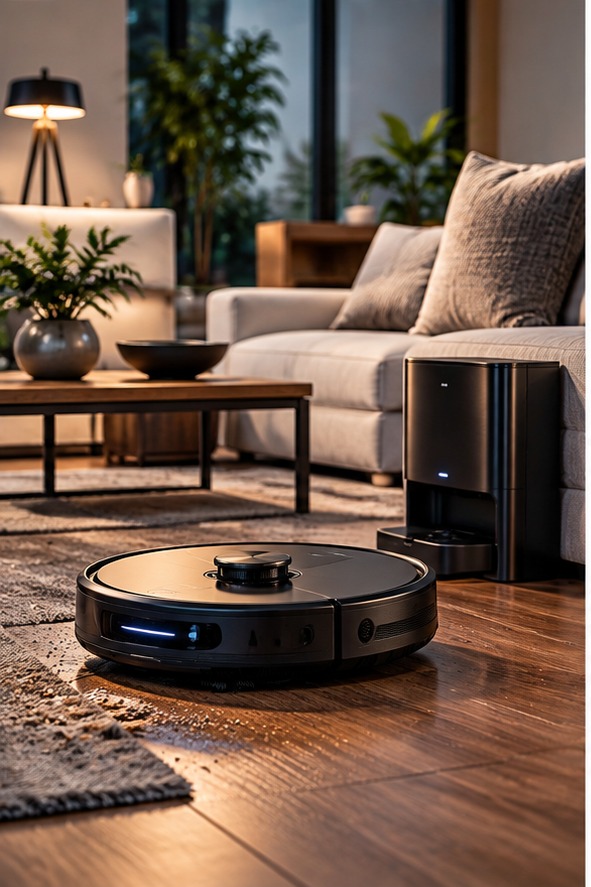
A modern robot vacuum is not just the circular machine on the floor. The dock can become the centre of the system, handling charging, dust collection, water management and mop maintenance. That makes dock size important. A self-cleaning station may save time, but it needs a suitable location near power and sometimes water. Measure the available area before buying. Also check consumables. Bags, filters, brushes, mop rollers and cleaning solutions can add to ownership cost. A cheaper robot can become less economical if its replacement parts are expensive or difficult to find.
Pets, carpets and clutter change the equation
Homes with pets need different priorities from minimalist apartments. Hair can wrap around brushes, food bowls can become obstacles and rugs can require stronger suction. A model that performs beautifully on an empty hard floor may behave differently in a busy family room. Carpet detection is another useful feature. A hybrid machine should know when to increase vacuum power and avoid putting a wet mop across a carpeted surface. The quality of that transition can matter more than the maximum advertised suction. If possible, map your home's difficult areas before choosing a model. Identify narrow gaps, raised thresholds, thick rugs and places where cables are regularly left on the floor. Those details give you a much better shopping checklist than a generic 'best robot vacuum' ranking.
Smart features and privacy
Cameras and microphones can improve obstacle recognition and remote monitoring, but they also raise privacy questions. A robot with a camera can sometimes reveal inside rooms while it is cleaning. Read the manufacturer's privacy information and check whether processing happens locally or through cloud services. Disable features you do not need and avoid placing the dock in a sensitive location if the machine has a camera. Smart-home convenience should not require surrendering more personal information than necessary. The best systems make privacy controls understandable and accessible.
Bottom line
Robot vacuums are becoming more capable because several technologies are improving at once: navigation, sensors, brush systems, mopping hardware and automated docks. For most buyers, navigation and maintenance are more important than the largest suction figure printed on the box. Think about your floor types, pets, clutter, thresholds and available dock space before comparing models. A premium robot can save meaningful time when its automation works reliably. For robot cleaning, the sensible target is not to own the most technically elaborate machine; it is to choose one that handles the specific cleaning problems your home creates.
Maintenance never disappears completely
Automation reduces work, but it does not remove it. Dustbins need attention, filters need cleaning, brushes collect hair and mop components need washing. Even a self-cleaning dock has tanks and trays that require periodic care. A useful buying question is therefore: what maintenance remains after the robot finishes its job? Look for accessible components, clear replacement schedules and reasonably priced consumables. The long-term experience is shaped by these small details. A robot that saves twenty minutes of daily vacuuming but takes an hour to maintain every weekend may not deliver the convenience its marketing suggests.
The right robot is the one that fits the floor plan
A large home may justify a larger battery, bigger dust capacity and a more capable dock. A compact flat may benefit from a smaller base and better low-profile navigation. There is no universal specification that matters most. Measure doorways, furniture clearance and docking space. Think about where the machine will live when it is charging, because a large station can be surprisingly difficult to place discreetly. The most useful comparison is therefore personal: match the robot's navigation, maintenance and cleaning system to the obstacles and surfaces in your own rooms.