The quiet wearable trend is getting louder
Smart rings have moved from niche accessories into one of the most visible parts of the wearable market. The appeal is easy to understand: a ring can collect health and activity signals without putting a bright screen on your wrist or asking you to wear another bulky gadget. Current 2026 coverage points to strong momentum for the category, with CCS Insight forecasting smart-ring shipments to grow substantially even while overall smartwatch shipments face softer demand. That contrast matters because it suggests consumers are not simply replacing watches; many are adding a smaller device for passive, always-on measurements. The interesting shift is not the ring itself. It is the growing emphasis on recovery, sleep, readiness and long-term patterns rather than simply counting steps. A ring is naturally suited to overnight wear, and that gives its software a large stream of information to work with. The result is a new style of fitness technology in which the device is less about showing you a workout on your wrist and more about helping you understand what happened between workouts.
Why the finger is becoming a useful sensor location
A ring has one major practical advantage: it stays on the body for long periods. People often remove watches for charging, exercise that involves contact with equipment, or because they simply do not want a screen on their wrist. A well-designed ring can feel more like ordinary jewellery, which lowers the friction of continuous wear. That does not make every measurement automatically better. Accuracy depends on sensor design, skin contact, fit, movement, temperature and the algorithms used to interpret raw signals. The useful question is therefore not whether a ring can produce a number, but whether it can produce a consistent trend that helps you make a sensible decision. For example, a single night of poor sleep is not necessarily a reason to cancel a training session. A repeated pattern of disrupted sleep combined with changes in resting heart rate or other recovery indicators may be more informative. Good wearable software should encourage that longer view rather than turning every daily score into a verdict.
Recovery scores are useful when treated as context
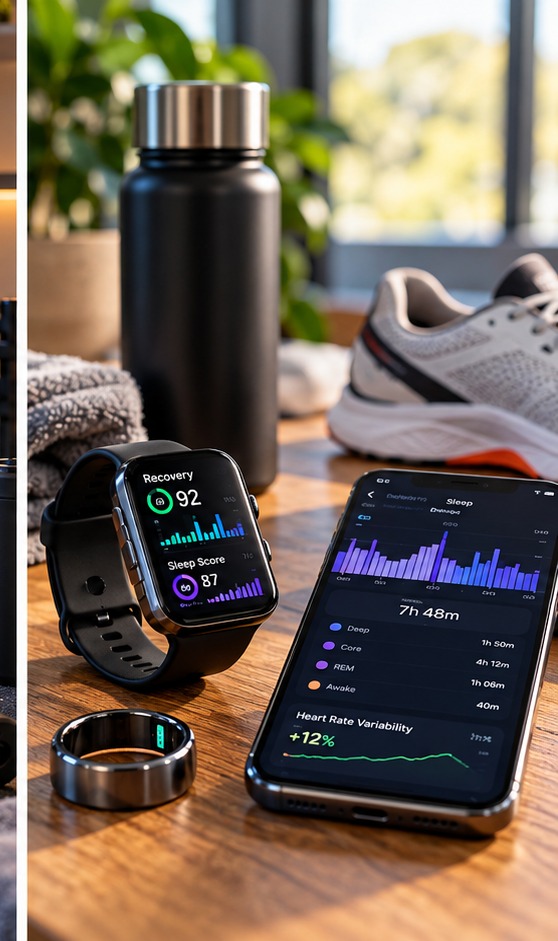
The rise of readiness and recovery scores is one of the biggest changes in consumer fitness technology. Instead of presenting separate measurements, software attempts to turn sleep, activity and physiological signals into an easier-to-read picture of how prepared you may be for the day. There is a major caveat. A recovery score is an interpretation produced by an algorithm; it is not a clinical diagnosis and is most sensible when used as a direct measurement of fitness capacity. Two platforms can process similar signals differently and produce different scores. That does not make the feature pointless. It can be valuable as a personal feedback loop. If your training volume rises while your sleep consistently deteriorates, a dashboard can make the relationship easier to notice. If the data remains stable while you feel energetic, it can reinforce what you are already experiencing. The strongest use case is therefore trend awareness, not chasing a perfect number.
What to examine before buying
Start with the sensor package and the software rather than the marketing language. Look for clear information about sleep tracking, heart-rate measurement, activity recognition and the way the company explains its scores. If blood oxygen, temperature or other measurements are advertised, check whether they are positioned as wellness features rather than medical diagnostics. Subscription terms deserve equal attention. A ring can be inexpensive at the point of sale yet become costly if important analysis is locked behind a recurring fee. Compare the total cost over two or three years, not just the box price. Fit is another practical issue. Rings come in multiple sizes and often need a sizing kit before purchase. A poor fit can be uncomfortable and may affect sensor contact. Think about your dominant hand, gym activities, manual work and whether you are willing to remove the ring for certain tasks. Finally, check ecosystem compatibility. Some platforms work best with a particular phone family, while others are designed to be more cross-platform. A technically impressive ring becomes much less useful if the app does not fit the devices you already use.
The data needs a human interpretation
The most useful wearable habit is to compare technology with lived experience. If a ring repeatedly reports poor recovery while you feel strong, investigate the pattern instead of blindly following the score. Conversely, if the dashboard looks normal while you feel unusually tired, your own experience deserves attention. This is particularly important because consumer wearables are not calibrated as universal measuring instruments. Hardware, algorithms, skin characteristics and usage patterns differ. A number can be consistent without being perfectly comparable with a number from another brand. That makes personal baselines valuable. After several weeks of normal use, you can learn what your typical sleep duration, resting measurements and activity patterns look like. Changes from your own baseline may then be more useful than comparisons with somebody else's score.
Smart ring versus smartwatch
These devices overlap, but they are not identical tools. A smartwatch is generally better when you need a screen, workout controls, GPS, notifications or detailed live exercise metrics. A ring is attractive when the priority is passive monitoring, sleep and low-profile wear. For some people, using both can make sense. The watch can handle a run or cycling session while the ring provides overnight data. Current industry research even suggests substantial overlap between smart-ring and smartwatch ownership, reinforcing the idea that the categories can complement each other. The right choice depends on what you actually want the device to do. If you mainly need pace, maps and workout controls, a ring alone may feel restrictive. If you want a discreet companion that quietly builds a long-term wellness record, its form factor can be compelling.
Bottom line
The 2026 smart-ring story is less about replacing the smartwatch and more about changing what wearable technology can feel like. Smaller hardware, longer periods of wear and increasingly sophisticated software are pushing the category toward continuous wellness tracking. The practical lesson is simple: buy the ecosystem, not the headline. Examine fit, battery life, subscription cost, phone compatibility, sensor capabilities and how the software explains its conclusions. Treat readiness and recovery scores as context rather than instructions. For people who value sleep and long-term trends and dislike wearing a watch all day, a smart ring can be a natural addition to a technology setup. For serious training that depends on live metrics, it is better viewed as one component of a broader toolkit.
A more sustainable way to use the data
Avoid checking a recovery dashboard dozens of times a day. The technology is most useful when it supports a routine rather than becoming the routine. A weekly review of sleep, activity and training can reveal patterns without turning every fluctuation into a concern. Use the information to ask practical questions: Did late workouts affect sleep? Does travel change recovery? Does increasing training volume require more rest? Those questions turn wearable data into something actionable. The broader appeal of smart rings is therefore not that they produce more numbers. It is that their low-profile design can make consistent tracking easier. Consistency gives software more context, and better context can make the resulting guidance more useful.